Ad / PR: this article contains affiliate links. If you book through one, gujo.guide may earn a small commission at no extra cost to you. Recommendations are never changed for commission — how this works.
How to Get to Gujo Hachiman Without a Car
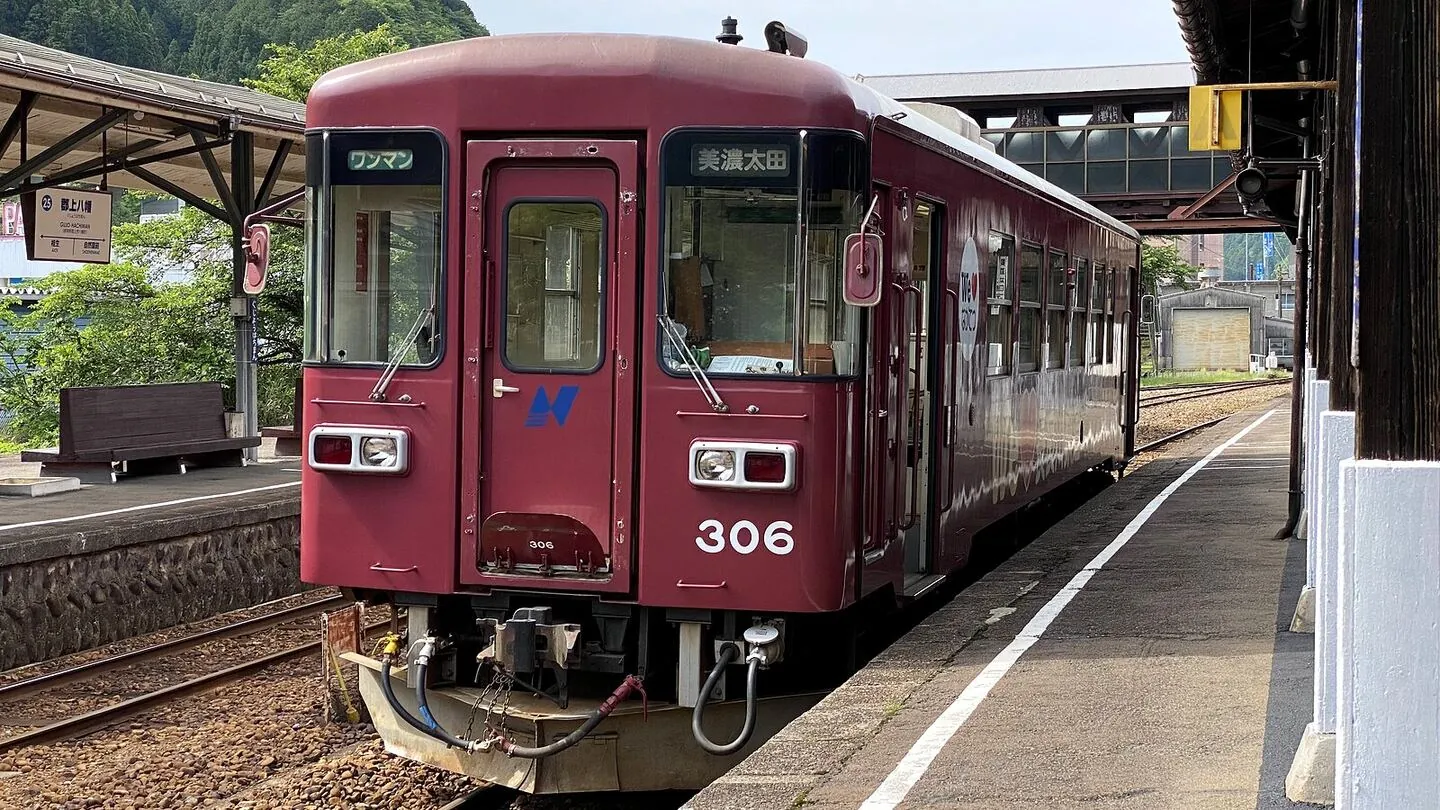
If you’ve searched for this, you’ve probably noticed most English guides give you one route and move on. In reality there are several realistic options — including driving yourself — and the “obvious” one has a catch that trips up a lot of visitors. Here’s the honest breakdown for reaching Gujo Hachiman’s old town specifically.
Heading to the ski resorts instead? Takasu Snow Park, Dynaland, and Meiho are a separate destination from the old town, with their own access routes — see our honest guide to getting to Takasu & Dynaland. This matters most in winter: a separate set of “ski bus tours” runs from Nagoya straight to the ski resorts during the season. Those are a different service to a different place — not an extra way to reach Gujo Hachiman. Outside of that, every route below runs the same way in summer and winter; the routes themselves aren’t seasonal.
If you’re flying in from outside Japan
Neither Narita nor Haneda connects directly to this area, and Centrair’s domestic network is limited too — so most international visitors end up routing through Nagoya regardless of which airport they land at.
- From Narita (NRT) or Haneda (HND): the simplest path is the Tokaido Shinkansen into Nagoya Station — roughly 1h40 from Tokyo/Shinagawa on a Nozomi service, which runs frequently (roughly 4–5 departures an hour on a weekday daytime, so there’s rarely much of a wait). Standard reserved-seat fare is ¥11,300 one-way. From Narita, budget extra time to first reach a Tokyo-area Shinkansen station (Narita Express or Keisei, around an hour). From Haneda, it’s a shorter hop into central Tokyo (monorail or train, 30–40 minutes) before the Shinkansen leg. A connecting domestic flight into Centrair is possible in theory but isn’t a common or reliably scheduled option from either airport — as of Centrair’s 2026 domestic network (19 cities, roughly 75 daily round trips), there’s no seasonal route that shortcuts this particular corridor, so don’t plan around one.
- From Centrair (NGO): take the Meitetsu Airport Line into Nagoya Station — about 30 minutes on a limited express, faster on the reserved-seat μ-SKY service. This is the easy leg.
The big picture
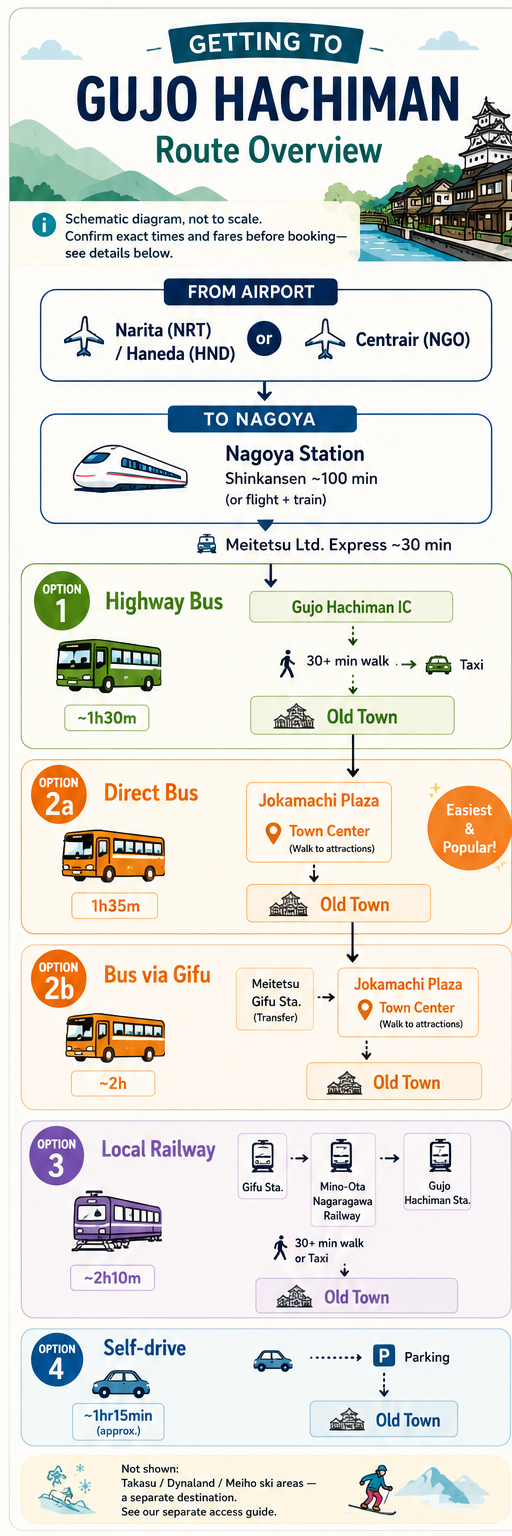
This is a schematic, not a surveyed map — use it to see how the pieces connect, then check the detailed breakdown below for the honest take on each option.
Quick comparison
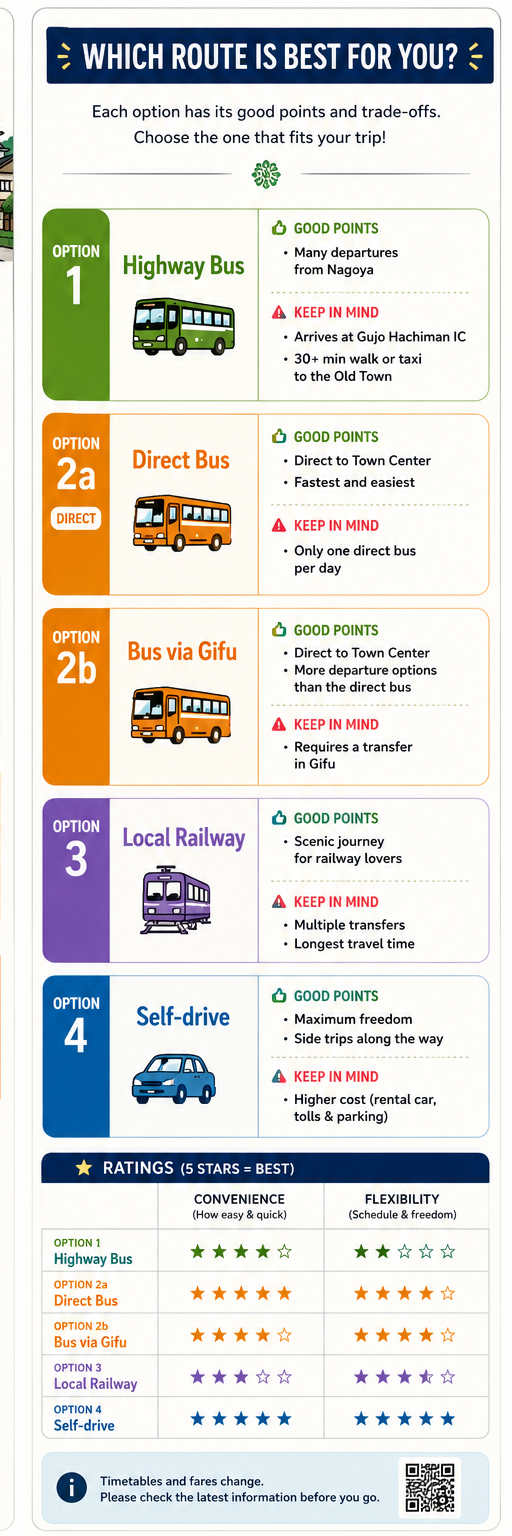
| Route | Time from Nagoya | Best for |
|---|---|---|
| Highway bus → Gujo Hachiman IC | ~1.5 hrs | Cheapest fare on paper, but not in the town center |
| Direct highway bus → Jokamachi Plaza | 1h35m | Fastest way into the town center — but just one departure a day |
| Train + bus via Gifu → Jokamachi Plaza | ~2–2.5 hrs | More departures, no taxi needed at the other end |
| Train + local railway | ~2.5–3 hrs | Train lovers, no luggage hurry |
| Rental car (self-drive) | Flexibility, comfort with mountain roads — skip this in winter unless you’re experienced |
Option 1: Direct highway bus from Nagoya (the popular but slightly misleading option)
Several highway buses run from Nagoya’s Meitetsu Bus Center or JR Nagoya Station toward Takayama, operated on a rotating basis by three companies (Meitetsu Bus, JR Tokai Bus, and Nohi Bus), and they all pass through a stop called “Gujo Hachiman IC.” It’s an easy 80–90 minute ride and the cheapest option on paper.
Confirmed fares (one-way, adult), from the operators’ official fare table:
| Route | Regular fare | Online-booking fare |
|---|---|---|
| Nagoya (Meitetsu BC / JR Nagoya) → Gujo Hachiman IC | ¥2,600 | ¥2,300 |
| Meitetsu Gifu / Takasu-Kakamigahara IC → Gujo Hachiman IC | ¥2,400 | — |
| Takayama (Nohi Bus Center) → Gujo Hachiman IC | ¥2,400 | ¥2,100 |
| Nagoya → Takayama (through fare) | ¥3,600 | ¥3,300 |
| Gujo Hachiman IC → Hirugano Kogen IC | ¥1,600 | — |
Buses from Nagoya run roughly once an hour from about 7:00 to the 20:30 range. One catch on the cheaper online fares: you have to complete the purchase by 24:00 the day before departure, or your reservation is automatically cancelled. Don’t leave it to the last minute assuming the discount will still be there — same-day, you’ll pay the regular fare.
Honest take: “Gujo Hachiman IC” is a stop on the expressway, not in the old town. It’s a genuinely confusing point — several operators serve it, and tourists who don’t know better assume it drops them in the historic streets. From there you’ll need a taxi (there usually aren’t many waiting) or the local reservation-required demand bus into town. Or, if you’re traveling light, it’s walkable — just over 30 minutes — into the old town. There’s nothing immediately around the bus stop itself, but about a 10-minute walk gets you to a FamilyMart, and Bishnu Devi (a genuinely good Indian/Nepali-run curry restaurant, open since 2013) is also nearby and open for lunch, so it’s not as bleak a stretch as it sounds. One real caution: Route 156 here carries heavy car traffic, so be careful if you’re walking alongside it. If you have a suitcase and want zero hassle instead, skip to Option 2 — both of its sub-options end within a short walk of the old town, no taxi needed.
Option 2: To Jokamachi Plaza — no taxi needed at the other end (the route I’d actually recommend)
Both of the following options end at “Gujo Hachiman Jokamachi Plaza,” which really is in the town center — a short walk from the castle town’s main streets. Pick whichever fits your schedule.
2a. Direct highway bus from Nagoya — no transfer at all
The Gifu Bus “Nagoya–Gujo Hirugano Line” runs straight from Nagoya’s Meitetsu Bus Center to Jokamachi Plaza with no transfer, continuing on afterward to Bokka no Sato and Hirugano Kogen Ski Resort. Confirmed fare: ¥2,400 one-way, Meitetsu BC to Jokamachi Plaza (¥2,800 through to Hirugano Kogen). On the current timetable, the bus leaves Nagoya at 8:40 and reaches Jokamachi Plaza at 10:15 — 1 hour 35 minutes, door to door, with stops at Takasu-Kakamigahara, Seki, Mino, and Gujo-Minami interchanges along the way.
The catch, and it’s a real one: this route runs just one round trip a day — it was cut back from two when the line was extended to Hirugano Kogen in 2022 — so it only works if that single departure actually fits your itinerary. Seats are reserved, not first-come; book through highwaybus.com or by phone (058-201-0489, weekdays 9:00–18:00 / weekends & holidays 9:00–17:00), from up to a month before your travel date. If you’re heading straight on to skiing, this bus is also worth knowing about for that leg — see our guide to getting to Takasu & Dynaland.
2b. Train to Gifu + Gifu Bus transfer — more departures, more flexible
Take a train from Centrair Airport or Nagoya to Meitetsu Gifu Station, then transfer to the Gifu Bus “Gifu–Hachiman Line.” This runs far more frequently than the direct bus above, at the cost of a transfer.
The bus leg alone (JR Gifu Station to Jokamachi Plaza) is a confirmed ¥1,800 one-way, about 1 hour 27 minutes over 66 km — Gifu Bus also sells a round-trip discount ticket for this route at ¥3,200 (valid 7 days from purchase). If you’re starting from Centrair or central Nagoya, there’s also a mobile-only combined ticket (the “Gujo Hachiman Transfer Ticket”) pairing the Meitetsu train with this bus leg: ¥3,060 from Centrair, or ¥2,220 from Meitetsu Nagoya (adult fares; both valid for 2 consecutive days from purchase). Worth buying through the CentX app before you travel if you’re taking this route.
Local Tip: if this is your first time coming to Gujo, I’d take this option myself. It runs far more often than the direct bus in 2a, and it still gets you right into the town center with no taxi at the other end — which makes the first hour of the trip a lot less stressful than gambling on a once-a-day departure.
This might not be for you if: you’re catching a late flight and need the fastest possible route — in that case Option 1 plus a pre-booked taxi from the IC is quicker, unless the 2a direct bus happens to line up with your schedule.
Option 3: Train + the Nagaragawa Railway (the scenic, slow option — and arguably a destination in itself)
From Gifu Station, take the JR Takayama Line to Mino-Ota Station (about 40 minutes), then change to the Nagaragawa Railway — a small, single-car local line — for the ride into Gujo Hachiman Station.
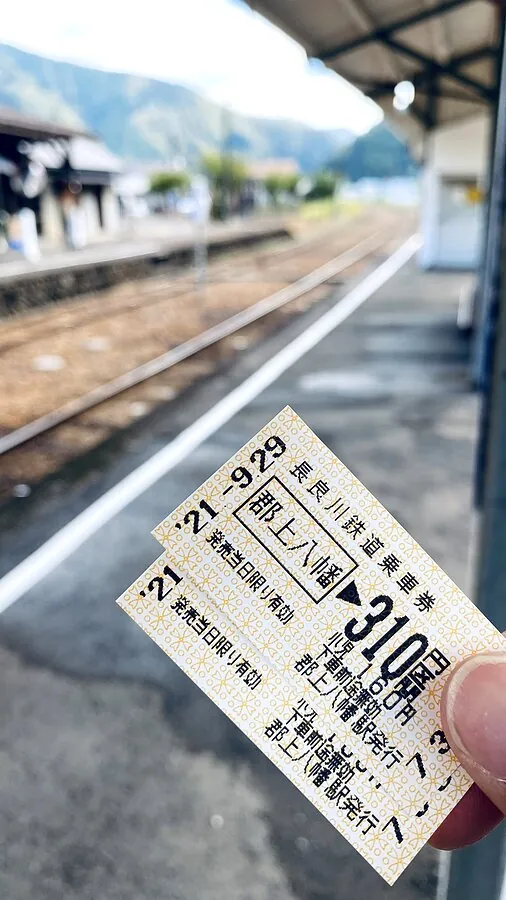
Honest take: this is genuinely the most charming way to arrive, and for some travelers the railway itself is part of the trip, not just transport. The line runs about 72km end to end, with roughly 50km of it tracing the Nagara River — one of Japan’s officially recognized “three great clear rivers” — so there are some genuinely good views along the way. It’s an old-fashioned no-conductor line — you board from the rear car, take a numbered ticket, and pay the driver at the front farebox when you get off, bus-style. Gujo Hachiman’s own station building still has its older wooden character, and if you’ve got time to spare, the one-day pass (confirmed: ¥2,700 for adults, ¥1,350 for children, covering the full line with unlimited stopovers) lets you hop off along the way — Minami-Kodakara Onsen Station has a hot spring bath right at the platform. Confirmed: there’s a discounted ¥300 bath here, but it’s tied to a separate ticket, the “Ichinichi Gujo Hachiman Coupon,” not the standard one-day pass above — worth knowing so you buy the right one if the onsen stop is the point. The full line has exactly four full-service staffed stations — Mino-Ota, Seki, Gujo Hachiman, and Mino-Shirotori (confirmed via the railway’s official station-hours page) — each with its own ticket-window hours; outside those hours (or at any other station), buy your ticket from the driver instead. The line is also rinko-friendly (boarding with a bagged, disassembled bicycle) — see our rinko cycling guide for the full rules if that’s part of your plans.
The catch: local trains aren’t frequent, and a missed connection at Mino-Ota can cost you over an hour. Don’t plan this route if your schedule is tight; do plan it if you enjoy slow travel and want photos out the window.
Option 4: Renting a car and driving yourself
If you’re comfortable driving in Japan, this is the most flexible option, especially if you’re combining this trip with other parts of Gifu. From Nagoya, it’s the Tokai-Hokuriku Expressway out to the Gujo Hachiman IC exit — confirmed: about 1 hour 10 minutes door to door on the expressway, with roughly ¥2,800 in tolls one way.
Honest take: outside of snow season (roughly April–November), this is a genuinely easy way to arrive — the old town is small enough that once you’ve parked, everything is walkable. The catch is parking itself, not driving: there’s very little legal roadside parking in the old town, and the narrow streets weren’t built for casual curbside stops. Use one of the paid parking lots near the edge of town rather than hunting for a spot on the street.
Warning: winter (roughly December–March) is a different matter. Snow (“studless”) tires or chains are mandatory in practice, not a nice-to-have — the mountain roads around Gujo ice over regardless of what the morning forecast said. A standard rental car without winter tires has no business on these roads in January or February; book specifically with winter tires fitted, and don’t assume a “regular” rental meets this. Locally, winter accidents caused by icy roads — including a fair number involving visitors unfamiliar with mountain driving — are common enough each year that this isn’t a hypothetical warning, it’s a recurring one. If you’re not confident driving on ice, take the bus or train options above instead. (See our guide to what first-time visitors should know for more on winter driving conditions generally.)
Option 5: Skip the routing entirely with a guided day tour
Everything above assumes you’re piecing the trip together yourself. If that sounds like more logistics than you want to deal with, a guided day tour from Nagoya covering Gujo Hachiman, Takayama, and Shirakawa-go handles the routing, timing, and language for you — at the cost of being on someone else’s schedule rather than your own.
Check the Nagoya–Gujo Hachiman–Takayama–Shirakawa-go day tour on Klook
This might not be for you if: you want to set your own pace in Gujo Hachiman specifically — group tours typically allow less time here than in Takayama or Shirakawa-go, since it’s the smallest of the three stops. If lingering in the castle town is the point of your trip, one of the self-guided options above will serve you better.
Getting around once you’re actually in Gujo
Once you’ve arrived, Gujo Hachiman’s old town itself is walkable — it’s compact enough that you don’t need a bus just to explore the historic streets. Where a bus actually earns its fare is the longer stretch between Jokamachi Plaza and Gujo Hachiman Station, about a 25-minute walk — worth knowing about if you’re heading back with shopping bags or luggage and don’t want to walk it. The city runs a local community bus called the Mame Bus (confirmed: flat fare ¥100 per ride, under-6s free; a ¥200 one-day pass and an 11-ride coupon book for ¥1,000 are also available). Red and Blue routes both loop from Jokamachi Plaza — Red covers 13.7 km, Blue covers 13.5 km, between them serving 39 stops around town, and each route runs about once an hour from morning to early evening. Confirm the current timetable locally once you arrive (or just ask at the Kinenkan), since timetables can shift.
Good to know before you go
- Payment: this is genuinely important — carry cash. IC cards (Suica/manaca, etc.) aren’t reliably accepted on the highway buses serving this area, and the same goes for the Mame Bus, many taxis, and plenty of small shops once you’re in town. Pay at the counter or on board for buses, and confirm payment method when booking. Don’t assume a card will work just because it worked in Nagoya or Tokyo — Gujo is a genuinely cash-first place.
- Luggage: highway buses generally have under-floor storage, but the local Nagaragawa Railway cars are small — a large suitcase will be awkward if the train is busy.
- If you miss the last bus back: services to/from Gujo Hachiman thin out in the evening. Check the return schedule before you head out for the day, not after.
- The Nagoya bus terminal situation: as of mid-2026, Meitetsu Bus Center is still operating from its original location near Nagoya Station — an earlier plan to relocate it in March 2026 was put on hold in December 2025 when the surrounding redevelopment schedule changed. This kind of thing can change again with little notice, so I’d recommend a quick check of the operator’s website the week before you travel, not just trusting this page (or any page) blindly.
Last verified: July 2026. Bus schedules and fares are revised periodically — please confirm exact departure times with the operator before booking, especially around seasonal timetable changes in spring and winter.
Heading to the ski resorts instead? Takasu Snow Park and Dynaland are a separate trip from the old town — see our honest guide to getting to Takasu & Dynaland if skiing is on your itinerary. Plenty of visitors do both in the same trip, just on different days.